Agitators are utilized in a wide range of industries including chemical processing, paint manufacturing, water & waste water treatment, food processing, mining & minerals, oil & petroleum, pharmaceutical, biotechnology, soaps, cosmetics and much more. Agitators are used for a number of applications such as liquid blending, emulsification, heat transfer, crystallization, gas dispersion, absorption, washing or leaching, dispersion and dissolution.
An agitator is a type of mixer used for materials with low viscosities in low-shear applications. There are different types of machines that perform agitation such as magnetic agitators or manual agitators. A washing machine is also considered to be an agitator. As far as liquid blending is concerned, these machines are excellent for mixing two or more liquids. Agitators will mix liquid materials to create a uniform mixture. Since agitators are used for substances with low viscosities and most emulsions have high viscosities, emulsification applications require scraped wall agitators that work along side with a high speed disperser.
Agitation is a very important step to avoid particle from settling at the bottom of a tank. Dissolution is a sub-category of solid suspension which involves forming a homogenous phase from a solution of solid particles in a liquid. Solid suspension pertains to keeping a slurry of solid particles mixed within a liquid. Essentially, the main function of an agitator is to create a certain level of uniformity between two or more liquids (or solid particles) within a vessel.
Thursday, October 16, 2014

Tuesday, September 30, 2014
Emulsifiers: Mixing and Then Some
How many different types of industrial mixers can you name? Mixers are used in a variety of ways across industries to create a variation of products. Though there are many variations each has a significant use. One type of mixer that creates many items we use everyday is an emulsifier. Emulsifiers create many food items and cosmetic items, among other products. So how do emulsifier mixers work and what kinds of products do they make? In addition to the mixer, certain additives may need to be added to create the final product solidifying the emulsion.
Emulsifier mixers are motorized blades and paddles that rotate on a stationary shaft inside of a tank to thoroughly combine any solid or liquid into a final product. The specific job will depend on the sharpness or dullness of the blades, small or large paddles. These mixers are effective because of their high shear abilities. This high shear ability allows for the mixer to create emulsions. Emulsifying is usually one of the first steps in the process of creating various new products. Therefore, they need to be reliable and durable to perform their job regularly with ease.
Where many mixers do exactly that, mix. Emulsifiers bring two or more substances into an irreversible blend. When an emulsion is complete the new product cannot be reversed into the substances they once were and do not need to be shaken or remixed like many other products. For example, some beverages are a mixture of different substances and will layer if the beverage was let to settle for a period of time. However, lotion on the other hand is much more stable as one product, which was emulsified into one substance from many. Even after sitting out for the same period of time the lotion will still look, feel and function exactly the same as the day it was made into an emulsion. Besides the mixer another aspect may be needed to finish the desired product.
Depending on the materials being mixed and the sought after viscosity, different times are needed to mix thoroughly. For example, cream cheese and liquid soap will take a different amount of time to be turned into their final form. To create a final product you need more than the mixing emulsifier. Additives are placed into the mixture. The most basic emulsions are water-in-oil and oil-in water. However, there are other natural (egg, soybean oil) and synthetic (polyethylene glycol, surfactants) emulsifiers used depending on the product. When these are introduced into the mixture it adds to the stability of the final product to keep its final form consistent and not settle back into the previous substances that were used to create the new product.
Emulsifier mixers are motorized blades and paddles that rotate on a stationary shaft inside of a tank to thoroughly combine any solid or liquid into a final product. The specific job will depend on the sharpness or dullness of the blades, small or large paddles. These mixers are effective because of their high shear abilities. This high shear ability allows for the mixer to create emulsions. Emulsifying is usually one of the first steps in the process of creating various new products. Therefore, they need to be reliable and durable to perform their job regularly with ease.
Where many mixers do exactly that, mix. Emulsifiers bring two or more substances into an irreversible blend. When an emulsion is complete the new product cannot be reversed into the substances they once were and do not need to be shaken or remixed like many other products. For example, some beverages are a mixture of different substances and will layer if the beverage was let to settle for a period of time. However, lotion on the other hand is much more stable as one product, which was emulsified into one substance from many. Even after sitting out for the same period of time the lotion will still look, feel and function exactly the same as the day it was made into an emulsion. Besides the mixer another aspect may be needed to finish the desired product.
Depending on the materials being mixed and the sought after viscosity, different times are needed to mix thoroughly. For example, cream cheese and liquid soap will take a different amount of time to be turned into their final form. To create a final product you need more than the mixing emulsifier. Additives are placed into the mixture. The most basic emulsions are water-in-oil and oil-in water. However, there are other natural (egg, soybean oil) and synthetic (polyethylene glycol, surfactants) emulsifiers used depending on the product. When these are introduced into the mixture it adds to the stability of the final product to keep its final form consistent and not settle back into the previous substances that were used to create the new product.
Thursday, September 11, 2014
Continuous vs. Batch Mixers
When it comes to industrial mixers, there are many viable options depending on application. Mixers can be classified into two categories; batch mixers and continuous mixers. Both have their advantages and can be used to mix concrete. Batch mixers are typically used to produce construction materials for interior and exterior projects whereas continuous mixers are applied in the food, chemical, pharmaceutical and manufacturing industries.
Batch mixers are industrial mixers used to produce precise mixtures in single batches. These are very high capacity mixers and can mix batches up to one thousand gallons. The typical batch mixer consists of a cylindrical tank with two opens. To mix raw materials, they are inserted into one end as the tank rotates. Once the materials are thoroughly mixed the mixture leaves through the opposite end into molds or troughs. Normal batch mixers are very large but they can be mounted on a wheeled frame to be more easily moved to strategic positions.
Continuous mixers mix as their name implies; continuously. They offer less flexibility than match mixers and have a chance of producing small variations to batches. However, they do require less staff to operate and are utilized when speed and efficiency is priority. To mix materials, a continuous flow of raw ingredients is fed into the machine and a flow of finished mixtures flows out the other end. This system is usually automated so there is no need to refill the mixer. Finished products out of continuous mixers are measure in grams per hour as opposed to the grams per batch measurements batch mixers utilize. Once again, both mixers have their advantages, it depends on what you priorities to determine which mixer is best suited for a particular project.
Batch mixers are industrial mixers used to produce precise mixtures in single batches. These are very high capacity mixers and can mix batches up to one thousand gallons. The typical batch mixer consists of a cylindrical tank with two opens. To mix raw materials, they are inserted into one end as the tank rotates. Once the materials are thoroughly mixed the mixture leaves through the opposite end into molds or troughs. Normal batch mixers are very large but they can be mounted on a wheeled frame to be more easily moved to strategic positions.
Continuous mixers mix as their name implies; continuously. They offer less flexibility than match mixers and have a chance of producing small variations to batches. However, they do require less staff to operate and are utilized when speed and efficiency is priority. To mix materials, a continuous flow of raw ingredients is fed into the machine and a flow of finished mixtures flows out the other end. This system is usually automated so there is no need to refill the mixer. Finished products out of continuous mixers are measure in grams per hour as opposed to the grams per batch measurements batch mixers utilize. Once again, both mixers have their advantages, it depends on what you priorities to determine which mixer is best suited for a particular project.
Wednesday, August 27, 2014
Kady Mills Shipped to Brazil
Scarborough, ME:
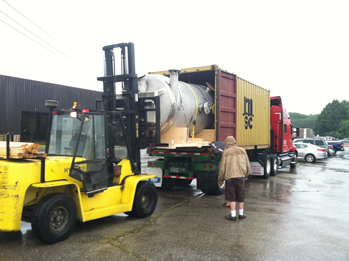
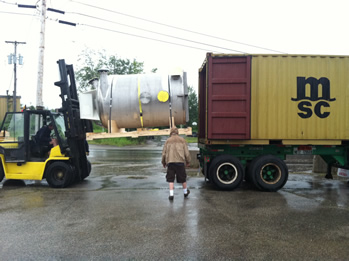
Kady International, an industry leader of high powered mixing equipment, has recently sent a shipment of Kady Mills to Brazil. Kady International has decades of experience providing mixers to international markets and their mills are in forty-one countries across the globe. These two particular large-scale Kady Mills which were sent to Brazil are designed to handle 1000 gallon batches and these will be utilized in a large minerals facility. The mills will process clay which will then be used for paper coatings.
These 350 horse powered machines have a continuous flow mode configuration and each mill will be able to handle approximately 700 gallons per minute. Kady International stresses the importance of delivering high quality industrial mixers which is why both of these mills were fully assembled and tested prior to shipping and then disassembled for shipment.
About Kady International:
KADY® International manufactures industrial mixers, and mixing equipment, high speed rotor-stator dispersion mills and fine mixing systems, for fluid/solid applications. KADY® International has successfully designed, engineered and manufactured mixing/dispersion equipment for almost fifty years.
Kady International, an industry leader of high powered mixing equipment, has recently sent a shipment of Kady Mills to Brazil. Kady International has decades of experience providing mixers to international markets and their mills are in forty-one countries across the globe. These two particular large-scale Kady Mills which were sent to Brazil are designed to handle 1000 gallon batches and these will be utilized in a large minerals facility. The mills will process clay which will then be used for paper coatings.
These 350 horse powered machines have a continuous flow mode configuration and each mill will be able to handle approximately 700 gallons per minute. Kady International stresses the importance of delivering high quality industrial mixers which is why both of these mills were fully assembled and tested prior to shipping and then disassembled for shipment.
About Kady International:
KADY® International manufactures industrial mixers, and mixing equipment, high speed rotor-stator dispersion mills and fine mixing systems, for fluid/solid applications. KADY® International has successfully designed, engineered and manufactured mixing/dispersion equipment for almost fifty years.
Wednesday, August 13, 2014
7 Common Types of Industrial Mixers
In the process manufacturing community, the mixing experts are the mixing equipment manufacturers, and they understand how different blades, speeds, mixer configurations and bowl shapes interact with different types of substances during the mixing process. There are nearly as many different types of mixing as there are products to be mixed – from industrial slurry adhesives to milk homogenization to bologna meat mixing, industrial mixers work differently to achieve smooth blending.
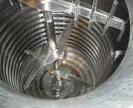 Agitators - A common example is the central agitating blade in a top-loading washing machine. It remains stationary on its center axis, agitating water and clothes with its paddle as it turns. Agitators in food and industrial product processing may have similar configurations, or they may be removable agitating rods which are placed into a substance only long enough to properly agitate it. Agitators are used in liquids, as agitation is not as effective with thick, highly viscous materials.
Agitators - A common example is the central agitating blade in a top-loading washing machine. It remains stationary on its center axis, agitating water and clothes with its paddle as it turns. Agitators in food and industrial product processing may have similar configurations, or they may be removable agitating rods which are placed into a substance only long enough to properly agitate it. Agitators are used in liquids, as agitation is not as effective with thick, highly viscous materials.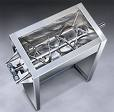 Ribbon Blenders – While blenders and mixers are basically synonymous, this type of blender is used in specific dry mixing of free-flowing bulk solids. Usually housed in a semi-cylinder, ribbon blenders have long, ribbon-like paddles which circle around a central axis, shearing through friable materials as the axis turns. Grains, pharmaceutical powders, powdered food ingredients like flour and many other solids are de-lumped or combined in this blender.
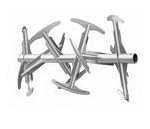 Paddle Mixers – Same configuration as ribbon blenders, but with paddle-shaped blades protruding from the axis instead of shearing ribbons. Also used to mix dry friables, but is also used in wet-dry mixing, slurry mixing and other high viscosity liquid mixing applications.
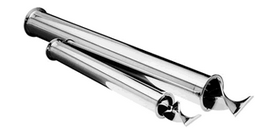 Static Mixers – AKA inline mixers, these smart pieces of equipment have no moving parts. Carefully designed ribbon-like obstructions are placed inside a cylinder through which liquids flow. As the liquid flows through, the obstructions inside cut the flow of the liquid, forcing it to mix and blend together. Inline mixers may be attached to flow tubes to enhance a liquid’s homogeneity without requiring power or servicing to moving parts.
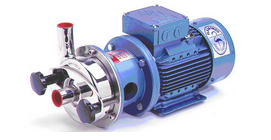 Emulsifiers - These may be inline, like static mixers, or a separate machine; both types are used in the blending of immiscible liquids such as oil and water or cream and milk. In inline and centrifugal emulsifiers, pressure is applied to the liquid-liquid mixture as it is forced through very small filters which break up larger molecules into smaller. In the case of milk and cream, cream is composed of large fat molecules which separate from milk due to the huge difference in molecule size; emulsification breaks cream molecules down so they are similar in size to milk molecules. Emulsification is sometimes achieved by adding emulsifying agents, by centrifugal force or by fast shearing.
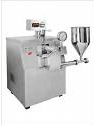 Homogenizers - Can be synonymous with certain types of emulsifiers. Homogenizers combine heterogeneous liquid-liquid mixtures by subjecting the mixture to extreme force and pressure, resulting in a breakdown and complete blending of the material. Most homogenizers have vertical axis shearing blades which blend within a closed container at very high speeds.
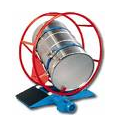 Drum Mixers – This is a broad category of mixers, and may include portable drum mixers which may be used for in-container mixing. Other drum mixers have their own container which materials must be poured into. Drum mixers are generally used to blend mixtures of low to medium viscosities such as cement or adhesive slurries; this particular mixer is capable of mixing substances of very different particle sizes, such as gravel and cement slurry or ice cream and fruit.
Wednesday, July 30, 2014
Food Mixers: The True Bakers
Food mixers are extremely important to the bakery business. In season, bakers can make over dozens of pies, cupcakes, cookies, muffins, pastries, and others. In order to keep with customer demand, they need to be ready to replace anything that might sell out. Particularly, this is important as the volumes of baked goods needed goes up. Bakers use a variety of different high tech baking equipment. One of these pieces of equipment is a super industrial food mixer. These mixers come in a variety of different sizes. There are ones that look like they would sit on your kitchen counter and there are ones that are ten times that size. These mixers are valuable to the baker because with of the time and money saved from the baking processes.
Any company that uses the baking process would find value from food mixers. Using the mixers increases production and efficiency around the work area with little manual labor and no labor to mix. There is a variety of different mixers on the market that can be purchased from personal use to industrial sized mixers. Most of us have small electric mixers that we use on a small scale to mix ingredients together when we are cooking. In the very olden days, early food mixers were operated by hand by turning a gear wheel connected to the beaters and the cranking motion would get them to turn. Most food production companies use even large mixers that mix thousands of pounds of ingredients all day, every day. With the absence of these mixers, baking companies would not be nearly as well off as they are today.
Any company that uses the baking process would find value from food mixers. Using the mixers increases production and efficiency around the work area with little manual labor and no labor to mix. There is a variety of different mixers on the market that can be purchased from personal use to industrial sized mixers. Most of us have small electric mixers that we use on a small scale to mix ingredients together when we are cooking. In the very olden days, early food mixers were operated by hand by turning a gear wheel connected to the beaters and the cranking motion would get them to turn. Most food production companies use even large mixers that mix thousands of pounds of ingredients all day, every day. With the absence of these mixers, baking companies would not be nearly as well off as they are today.
Wednesday, July 16, 2014
How Ice Cream and Mixing are Related Through Agitation
Agitation is the trick for homemade ice cream. There are hundreds of recipes out there that claim to have all the right ingredients. But to make true ice cream there is a quintessential process for the mixture to have a cream-like texture. Shaking and stirring is the key to allow the ingredients to become thoroughly smooth and mixed. Most ice creams have basic requirements such as cream, sweetener and milk. But if you were to put all of the best components from the ice cream recipes in the freezer without agitation then you will end up with a frozen block of mess.
Have you ever experimented with making your own ice cream? It would be extremely difficult without the convenience of an agitation mixer. Some ice cream agitators use ice cubes and salt to reach needed temperatures to freeze the cream, but with our maker it utilizes a double-insulated bowl. Then the inner layer gets a frozen gel which cools the ice cream. After you finish churning, you wash the bowl and then place it back in the freezer until next time. One of the down sides of the insulated bowl is that once the inner layer is thawed, it will not make more ice cream. This means that if you want to make several batches then you will have to use an alternative method. But with any method you choose, agitation will be key
Have you ever experimented with making your own ice cream? It would be extremely difficult without the convenience of an agitation mixer. Some ice cream agitators use ice cubes and salt to reach needed temperatures to freeze the cream, but with our maker it utilizes a double-insulated bowl. Then the inner layer gets a frozen gel which cools the ice cream. After you finish churning, you wash the bowl and then place it back in the freezer until next time. One of the down sides of the insulated bowl is that once the inner layer is thawed, it will not make more ice cream. This means that if you want to make several batches then you will have to use an alternative method. But with any method you choose, agitation will be key
Subscribe to:
Posts (Atom)